Amazon Gaming Week 2026: Best Retro Remake & Switch 2 Deals
April 29, 2026
Introducing the Roblox Hybrid Architecture: Democratizing Photorealistic, Multiplayer Gaming
April 30, 2026
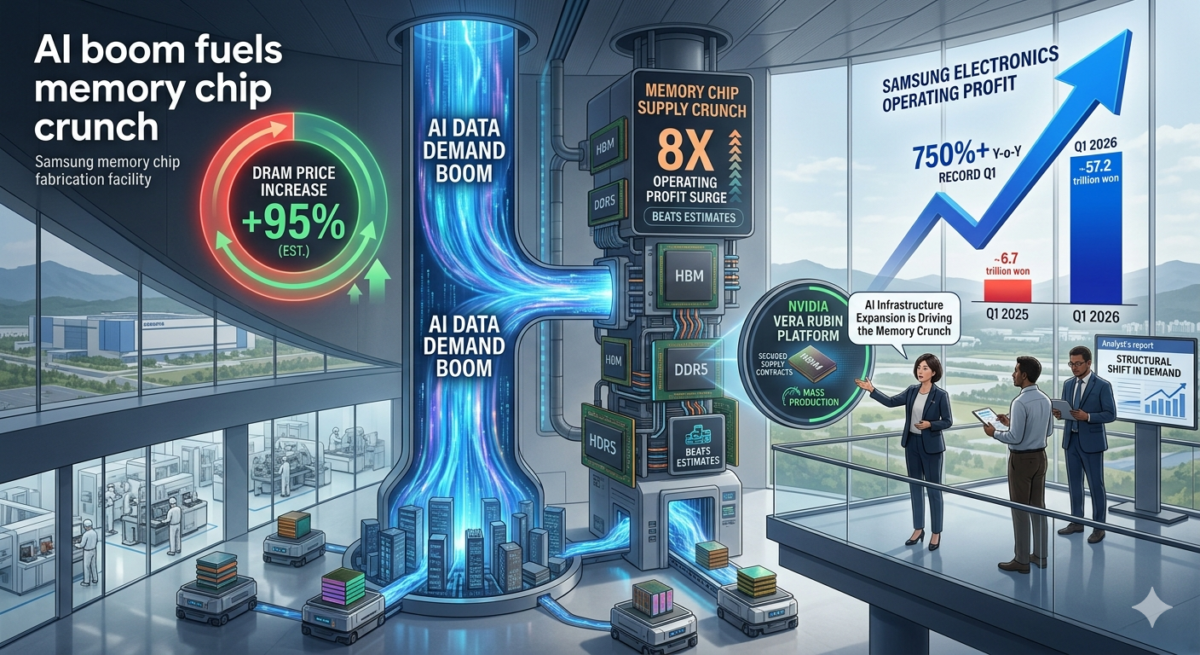
Samsung Profit Surges Over Eightfold to Beat Estimates as AI Boom Fuels Memory Chip Crunch
The global technology landscape witnessed a historic financial turnaround on April 30, 2026, as Samsung Electronics released its definitive first-quarter earnings report. The results confirm a staggering reality: Samsung profit surges over eightfold to beat estimates as AI boom fuels memory chip crunch. This monumental leap marks the end of the post-pandemic semiconductor slump and signals the beginning of an era where artificial intelligence serves as the primary engine for global hardware demand.
1. The Financial Explosion: Breaking Down the Surge
Samsung’s performance in the first quarter of 2026 has been described by market analysts as nothing short of “stupendous.” After a difficult 2023 and a recovering 2024, the company has officially returned to record-breaking profitability.
- Operating Profit Growth: The company flags an eightfold jump in Q1 profit, a figure that significantly outpaced the most aggressive consensus estimates from Wall Street and Seoul.
- The Semiconductor Pivot: The Device Solutions (DS) division, which handles memory chips, has transitioned from a loss-making burden to a high-margin powerhouse.
- Record Levels: Industry insiders noted that Samsung elec is likely to report a stupendous surge in quarterly profit to record level, driven by the premium pricing of next-generation components.
2. The AI Chip Crunch: Why Demand is Skyrocketing
The driving force behind this recovery is the global “AI arms race.” Tech giants are engaged in a massive infrastructure build-out to support increasingly complex Large Language Models (LLMs).
- HBM3E Dominance: High Bandwidth Memory (HBM) is the “fuel” for AI processors. Samsung’s rapid scaling of HBM3E production has allowed it to capture a massive share of the orders coming from GPU manufacturers like NVIDIA.
- The Enterprise SSD Boom: It isn’t just about speed; it’s about storage. AI data centers require vast amounts of high-speed enterprise SSDs. Samsung’s sales in this sector have reached triple-digit growth as companies move away from traditional hard drives.
- Meta’s Influence: As Meta to open source versions of its next AI models, the barrier to entry for AI development has dropped. This has led to a secondary wave of demand from smaller enterprises and startups, further tightening the global chip supply.
3. Supply Chain Dynamics and Price Hikes
The “memory chip crunch” mentioned in the earnings call is a double-edged sword. While it drives Samsung’s profits to new heights, it creates challenges for the broader electronics industry.
- End of Oversupply: The glut of memory chips that plagued the industry in 2023 is officially over. Samsung’s strategic production cuts in 2025, combined with the AI surge, have created a “seller’s market.”
- DDR5 and Specialized RAM: Standard consumer RAM is also seeing price increases as Samsung shifts its production lines toward more profitable AI-specialized chips.
- Inventory Replenishment: Major smartphone and PC manufacturers are currently rushing to replenish their inventories before prices climb even higher, further fueling the profit surge.
4. Mobile and Display: The Supporting Cast
While the headlines are dominated by chips, Samsung’s other divisions provided the necessary stability to beat overall estimates.
- Galaxy AI Integration: The latest Galaxy S-series smartphones, heavily marketed with “on-device AI” features, have seen strong sell-through rates. These devices use Samsung’s own high-end memory, creating an internal ecosystem of profitability.
- OLED Dominance: Samsung Display (SDC) continues to lead the market for high-end smartphone panels. As rivals transition more of their lineups to OLED, Samsung’s display margins have remained resilient.
5. Challenges and Competitive Pressures
Despite the record profits, the path forward is not without competition.
- SK Hynix and Micron: Samsung’s regional rivals are also reporting strong numbers, leading to a fierce battle for “first-to-market” status with HBM4 technology.
- Geopolitical Factors: Ongoing trade tensions and domestic manufacturing incentives in the US and Europe mean Samsung must carefully navigate where it builds its next-generation fabs.
- Sustainability of the AI Boom: Critics often ask if the AI spending spree is a bubble. However, Samsung’s 2026 outlook suggests that the integration of AI into corporate software is only in its “early innings.”
6. Strategic Conclusion: The 2030 Vision
Samsung’s Samsung Q1 2026 profit report is more than just a win for shareholders; it is a proof of concept for the company’s long-term strategy. By betting heavily on AI-specific hardware years ago, Samsung has positioned itself as the indispensable foundation of the modern tech world. Whether it is the chips in a data center or the AI in your pocket, Samsung is capturing value at every level of the stack.
Frequently Asked Questions (FAQs)
1. What does an “eightfold jump” mean for Samsung’s stock?
An eightfold jump indicates that the company’s operating profit is 800% higher than the same period last year. This typically leads to a significant increase in investor confidence and a higher valuation for the company’s stock.
2. Why is there a “memory chip crunch” right now?
The crunch is caused by a massive gap between supply and demand. AI models require much more memory than traditional software, and manufacturers like Samsung cannot build new factories fast enough to keep up with the sudden surge in orders.
3. How much of Samsung’s profit comes from AI?
While Samsung doesn’t always break out “AI-only” profit, analysts estimate that over 60% of the growth in the semiconductor division is directly linked to AI-related hardware, such as HBM chips and high-capacity SSDs.
4. Will this profit surge lead to more expensive smartphones?
Indirectly, yes. As the cost of memory chips increases due to the crunch, the “Bill of Materials” (BoM) for smartphones and laptops goes up. Manufacturers often pass these costs onto consumers in the form of higher retail prices.
5. What is the significance of Meta’s open-source AI in this report?
Meta’s open-source strategy (like the Llama models) allows thousands of companies to build their own AI tools. Each of these companies needs server space and memory, which creates a massive, global customer base for Samsung’s chips.